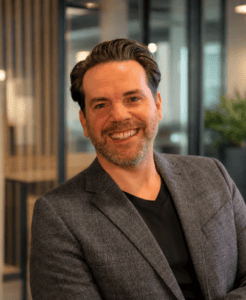
As social housing faces mounting pressures, ROCC’s Managing Director, Peter Luck, believes the answer to these challenges lies in building around people. In this exclusive interview, he explores AI, resident safety, innovation and why genuine partnerships remain the foundation of long-term success.
ROCC has been onboarding record numbers of new customers over the last 12 months, and its reputation as a trusted technology partner has grown hugely in the housing market. How proud are you of the progress that’s been made?
I’m incredibly proud of what our team has achieved, although if I’m honest, I probably don’t stop often enough to say that or celebrate as much as we should. It’s been a remarkable year for ROCC for so many reasons. We’ve welcomed more new customers than ever before, delivered fantastic projects and continued to build really strong relationships across the housing sector.
What probably makes me proudest isn’t the number of contracts we’ve won; it’s the reasons we’ve won them. More and more organisations are choosing ROCC because we are trusted, and if we say we’ll do something, we always do it.
We develop and implement amazing software, with new modules and features released throughout the year, and we are also transparent. If there is a gap, we openly talk about it, accept it and do something about it. Our customers know we’ll work alongside them as partners and we’ll genuinely care about helping them improve their housing maintenance services rather than simply selling them another piece of software.
I love each new customer relationship we enter, with that magic moment when they realise we are going to help and support them, not just find reasons to charge them extra money.
I think our reputation today has been built over many years of consistently focusing on doing the right thing. Our ambition has always been to have the best housing maintenance software, but above that we’ve always wanted to be the company people trust when the stakes are high. A company that people turn to when things aren’t going great. That’s something you can’t buy with marketing and PR; it comes from hundreds of people, over many years, delivering on their promises.
There’s also a huge amount of hard work behind the scenes that customers never see. Winning new business is fantastic, but onboarding record numbers of customers whilst continuing to look after our existing ones takes an enormous team effort. Everyone at ROCC has played a part in that success, and they deserve a huge amount of credit.
The exciting thing for me is that I still feel we’re only scratching the surface. We have an exceptional team, an ambitious product roadmap increasingly shaped by our customers, and a clear vision of where we want to take the business over the next few years. That gives me a huge amount of confidence about what comes next.
The social housing sector is under increasing pressure to improve service quality while managing tighter budgets. Where do you think technology can make the biggest difference for housing providers today?
I think there’s a real temptation at the moment to view technology purely as a way to reduce costs, but I actually think that’s far too simplistic. Housing is fundamentally about people, and technology providers should be there to offer solutions that help good people do a better job, not replace them.
Modern workplaces have steadily heaped more and more pressure on people over the last 30 years, so for me, the biggest opportunity is proactively providing people with better information and removing as much friction as possible from their day. Whether it’s helping a contact centre team member diagnose a repair correctly the first time, giving a trade operative everything they need before they arrive on site or providing managers with real-time insight into what’s happening across the organisation, technology should help people make better decisions more quickly.
AI is obviously a huge topic, and it’s going to transform our industry, but I think we need to use it responsibly and always be conscious of the long-term impacts to our communities. If businesses continue to view AI as a quick fix to reduce headcount, we risk losing decades of critical human knowledge and experience from the housing sector. If we use it to remove repetitive tasks, highlight risks, analyse trends and give housing professionals better information, then it becomes incredibly powerful.
This is probably the most exciting and disruptive time I’ve ever seen from a technology perspective. The opportunities for us all are huge; however, ultimately, I don’t think customers judge their housing provider by the technology they use. They judge them by whether repairs are completed on time, whether appointments are kept, whether their homes are safe and in good condition, whether they feel heard, and whether they feel cared for and valued. Good technology should sit quietly in the background, making all of that easier. If it’s doing its job properly, the resident notices a better service, not better software.
I think that’s where the real opportunity lies, and it’s certainly how we think about product development at ROCC. Every feature we build starts with the same question:
“How does this help someone deliver a better service to the resident? That’s the measure that really matters.
What are the most exciting developments currently on the horizon at ROCC, such as new software capabilities and tools?
It’s a really exciting time for us because we’re investing heavily in areas we genuinely believe will make a difference for our customers, rather than simply following the latest technology trends. Our roadmap backlog is enormous, filled with everything from major new product and module releases this year to simple, everyday tweaks that just make day-to-day work a bit easier for our user base.
AI is obviously a huge focus, and as I have already said, we are making sure we deliver features that help people do good things. AI will be embedded directly into the day-to-day experience of housing professionals, giving all members of staff instant access to guidance, policy information and operational knowledge, helping them make quicker, more informed decisions without having to search through documents or ask colleagues for help. It’s about giving every member of staff an experienced digital colleague sitting alongside them.
We’re also doing some really exciting work in business intelligence, supporting housing providers in making sense of the huge volumes of data they have. Our ROCC Focus business intelligence platform has been a game changer for many providers in terms of proactive information being offered up to them, but our next generation of AI-powered analytics won’t just show customers what’s happened; it will explain why it’s happening, highlight emerging trends, identify risks before they become problems and even suggest practical actions to improve performance. That’s a huge step forward from traditional reporting.
It’s not all about AI though, and it’s important that technology providers don’t forget that. We certainly aren’t and we’re continuing to invest right across the ROCC platform. We’re enhancing our scheduling capabilities, strengthening our mobile solutions, expanding our integration framework and developing new products that give organisations even greater visibility and control over their repairs and maintenance services.
One area I’m personally really excited about is providing customers with benchmarking and performance insights, helping them understand not only how they’re performing, but how they compare with similar organisations across the sector and where the biggest opportunities for improvement lie.
What ties all of this together is a really simple philosophy that we work to every day. We don’t build technology because it’s clever and shiny; we build it because it helps housing providers deliver a better service to their residents. If a new capability saves someone time, helps them make a better decision, or improves the experience for a resident, then that’s exactly the sort of innovation we want to invest in.
Compliance and resident safety are currently critical topics in social housing. How is ROCC helping organisations respond to evolving regulatory expectations and legislation?
Resident safety is rightly one of the biggest priorities in social housing and the pace of regulatory change isn’t slowing down. With the continued rollout of Awaab’s Law and the expansion of requirements to cover a much wider range of hazards, alongside the ongoing evolution of the Housing Health and Safety Rating System (HHSRS), housing providers are under increasing pressure to demonstrate that they’re identifying risks quickly, acting within strict timescales and maintaining a clear audit trail of every decision they make.
At ROCC, we’ve always believed that compliance shouldn’t be something you think about after the event. Compliance should be built into the way you work every single day, and that’s why our platform helps organisations manage the entire lifecycle of a repair or safety issue, from the moment it’s reported through to diagnosis, prioritisation, scheduling, completion and resident communication, with a complete audit trail throughout. If regulators ask, “What did you know, when did you know it, and what did you do about it?”, our customers have that information at their fingertips and can respond accordingly.
Compliance is about much more than simply ensuring the right boxes are ticked on the right form. It’s about giving housing providers the confidence that they’re doing the right thing at the right time, protecting residents and demonstrating that they have robust, repeatable processes in place. If technology can help achieve that, then it’s making a genuine difference.
You’ve spent more than 28 years in the IT and housing technology sector. What changes have surprised you most in how housing providers now approach repairs and maintenance?
When I first started working with housing organisations nearly three decades ago, and if I’m honest right up until about five or so years ago, I used to hear the same thing time and time again: “Repairs is the poor relation in the organisation.”
It was often seen as just a necessary service rather than a strategically critical one. Investment tended to go into other parts of the organisation, while repairs teams were expected to keep delivering with ageing systems, limited information and very little recognition for just how important their role was.
Although it hasn’t been surprising, what has been really encouraging over the last few years is seeing that mindset slowly change at the leadership level. Housing providers now finally recognise that the repairs service is one of the biggest influences on resident satisfaction. If a tenant has a leaking roof, no heating or damp and mould in their home, it doesn’t really matter how good the organisation’s online presence is or how much is invested in comms strategies. Their experience of the organisation is shaped by how quickly, professionally, and compassionately the issue is resolved and remains resolved.
I think regulation has certainly accelerated that mindset shift, but so has a genuine desire across the sector to improve services and put residents first. Housing providers are investing far more in their repairs teams, their processes and the technology that supports them, and this is exactly as it should be. They’re looking at data more intelligently, using mobile technology, embracing AI and focusing much more on prevention rather than simply reacting when something goes wrong.
What hasn’t changed, though, is the passion of the people working in housing. I’ve met thousands of housing professionals over the years, and the vast majority genuinely care about making a difference to residents’ lives. Technology has moved on enormously, but for me it’s still about giving those people the tools, information and confidence to do the job they came into housing to do.
That’s probably the biggest change I’ve seen. Repairs and maintenance is no longer viewed as the poor relation. It’s increasingly recognised as one of the most important services a housing provider delivers, and I think that’s exactly where it should be.
From your perspective, what are the biggest operational challenges social housing providers will face over the next decade?
I think there are quite a few challenges ahead, but if I had to pick one overarching theme, it’s that housing providers will be expected to deliver significantly more with increasingly limited resources. Exactly what I would have said if asked this question 10 years ago and probably what I will say in another 10 years’ time. The pressures just keep on mounting up.
The expectations from residents, regulators and government will continue to rise, and rightly so, but organisations are going to have to balance that with financial pressures, ageing housing stock and the challenge of recruiting and retaining skilled people. That’s not an easy combination.
I also think we’re going to see a real shift in the skills people need as AI and automation become part of everyday working life, but I don’t believe they’ll replace housing professionals. If anything, they’ll make experienced people even more valuable because they’ll have better information at their fingertips and be able to make better decisions more quickly. The organisations that succeed won’t be the ones with the most AI; they’ll be the ones that combine great people with great technology.
Another challenge will be moving from reactive to genuinely predictive. We launched our predictive analytics module for ROCC years ago, and so we have been talking to organisations about this for a long time. Unfortunately, though, most people are still not utilising technology to help them forecast, and are missing business-critical information that could truly help them provide the very best services. I think the next decade will be the time when that really becomes day-to-day and normal practice for organisations.
Finally, and this is something I feel quite strongly about, I think collaboration will become increasingly important as the challenges facing social housing are simply too big for any one organisation to solve in isolation. Whether that’s sharing ideas, learning from one another, benchmarking performance or working more closely with technology partners, the organisations that are open to collaboration will be in the strongest position.
When I look ahead, I’m actually very optimistic. Housing has always attracted people who genuinely want to make a difference, and if we can equip them with better technology, better insight, and more time to focus on residents, I think the sector can achieve an incredible amount over the next 10 years.
What feedback are you hearing directly from social housing providers right now about dealing with existing challenges in the sector?
The thing that strikes me most is that housing providers aren’t looking for miracles as they perhaps did 10 or 15 years ago. They know the challenges they’re facing, and they’re incredibly realistic about them. So what they’re asking for is technology and partners that genuinely help make those challenges more manageable and will work with them to find the right solution to each problem.
The biggest topic of conversation is probably balancing legislation and resident expectations with the financial reality they’re operating in. Everyone wants to improve services, respond more quickly, and invest in their homes, but they’re having to make some very difficult decisions about where to spend their budgets and how to get the best value from every pound.
Another theme that comes up time and again is people. Although this has been ongoing for quite a few years now, it is definitely getting worse. Recruiting and retaining experienced staff, whether field operatives or office workers, is still a challenge, but equally important is ensuring the people they already have can spend their time adding value rather than battling systems, duplicating work, or searching for information.
The other thing I hear a lot is that housing providers are now looking for genuine partnerships. Relationships used to be very much “We are the customer and you are the supplier”, but that has changed. Most organisations are on their second, third, or fourth generation of technology providers, and they have realised that they don’t just want a software supplier that installs a system and disappears to win the next deal. They want someone who understands the sector, listens to their challenges, shares ideas and helps them improve over the long term.
That’s something we’ve always believed in at ROCC. The best relationships are the ones where we solve problems together, because ultimately we all share the same objective: delivering better service for residents.
ROCC often talks about partnership and collaboration with customers rather than simply supplying software. Why is that philosophy important to the business?
I’ve always believed that if your relationship with a customer is purely transactional, you’ve got it wrong.
We’re not selling somebody a laptop or a piece of office furniture. Our software becomes part of the day-to-day operations of a housing provider and is critical not only to the organisation’s success but also to the success and often the happiness of the individuals using it. It supports thousands of repairs, thousands of staff members, and ultimately affects the experience of hundreds of thousands of residents. That’s not something you can just install and walk away from. Certainly not if you work at ROCC anyway. We expect so much more from ourselves.
I’ve always said to our team that our job isn’t to sell software; it’s to help our customers solve the challenges that are preventing them from providing better housing services. Sometimes that means developing new functionality quickly, sometimes it’s helping them rethink a process, sometimes it’s simply sharing something we’ve seen another organisation do really well. Sometimes it’s even about us sitting together, neither of us knowing how to fix this, but working together until we figure it out. If we can help them improve, everyone benefits.
One of the things I’m most proud of is that our customers always become partners and, often on an individual basis, become friends. I joined ROCC as a junior in our customer service team, and there have been customers whom I have worked with for over 25 years. I get personal WhatsApp messages from customers all the time. Sometimes asking me to help, sometimes just checking in and seeing how we’re doing, or sometimes just letting me know how they are doing.
I’m not proud because this is happening to me; I’m proud because I see it happening throughout the ROCC team. I love visiting customers with members of our team and seeing my ROCC colleagues hugged as they arrive and welcomed to the organisation as friends. That doesn’t happen overnight; it happens because we hire people who have a passion for helping, genuinely care about doing the right thing for our customers and consistently display this care over many years.
I’m also exceptionally proud of how our customers are so invested in ROCC doing well, succeeding and delivering exceptional software and services. Through initiatives like our Strategic Advisory Board (R-SAB), they’re not just buying software; they’re helping shape it, working directly with our teams to design it, test it, and make sure it meets the challenges it was intended to solve. That means when we release software, it is driven by real operational challenges rather than what we think might be a good idea sitting in an office.
I also think partnerships are built on honesty. If something can be done better, we’ll say so. If we don’t think a particular approach is right, we’ll have that conversation. If we make a mistake, we own it, and we resolve it. Equally, our customers are honest with us, and that’s how trust develops over time.
As I’ve mentioned, some of our customer relationships go back well over 25 years now, and I don’t think that’s because we’ve always had the best features in our software. I think it’s because we’ve consistently tried to be the sort of partner that people want to work with, that listens to them, responds to them and cares about them. We genuinely want to see them deliver the very best service they can for their residents and we want to help them achieve that.
For me, that’s what partnership really means. If we focus all our energy on helping our customers succeed, we will also succeed. It’s as simple as that.
Looking ahead, how do you see technologies like AI, real-time analytics and automation changing the day-to-day work of housing maintenance teams?
I think we’re at the beginning of one of the biggest technological shifts the housing sector has ever seen, but I hope, like me, they will see this technology as a way not to replace people but to make them better.
For years, we’ve been asking housing professionals to make important decisions based on incomplete information gathered from multiple systems, to interpret large amounts of data and to rely on their own experience to decide what’s most important. AI changes that. It can bring together information in seconds, identify patterns that a human might never spot and present people with the insight they need to make better decisions.
Take a customer service adviser as an example. AI will work alongside them, analysing the conversation in real time, identifying potential risks, highlighting previous history, suggesting the most appropriate response and even drafting communications to the resident. The adviser still makes the decision, but they’re supported by an incredibly knowledgeable digital colleague.
The same applies to trade operatives. Imagine an operative arriving at a property with the full repair history, photographs, asset information, manufacturer guidance, AI-generated recommendations already waiting for them and an assistant available to discuss what they are seeing and help them determine the best actions to take.
Real-time analytics will become equally important. Rather than looking at what happened last month, organisations will be able to see what’s happening right now and, more importantly, what is likely to happen next week, next month, next year or in 10 years’ time. That’s when you start preventing problems instead of simply reacting to them.
Automation will continue to quietly remove much of the repetitive administrative work that frustrates people today. Things like updating records, scheduling appointments, generating letters, chasing information and moving work through workflows can increasingly happen automatically in the background. That gives people back something that’s becoming increasingly valuable: time.
The important thing, though, is remembering why we’re doing all of this. Technology shouldn’t be implemented just because it’s clever or the latest trend. I have spoken on many occasions about AI Fluff (or AI for AI’s sake), and we need to all be careful not to implement poorly thought-out solutions just because there is an AI badge on it.
AI should be implemented because it helps housing professionals spend less time looking at screens and more time focusing on residents. Less time clicking and more time talking. Less time trying to find out what’s happening and more time planning for what will happen.
If AI, analytics and automation can help organisations deliver safer homes, faster repairs and a better customer experience, then that’s where the real value lies. That’s the future I think we’re all working towards together.
What’s your long-term vision for ROCC over the next three to five years? What does success look like?
Success, for me, isn’t about becoming the biggest company in the sector or making the most money. It’s about becoming the company that housing providers most want to work with because they trust us, they enjoy working with us and they know we’ll help them succeed. I want people to want to work with us, not because of what we sell but because of who we are.
Over the next three to five years, I want ROCC to continue pushing the boundaries of what’s possible with technology. AI is going to transform how housing organisations operate, and I genuinely believe we have an opportunity to be at the forefront of it. However, only if we use it properly. Our focus will always be on solving real problems rather than developing technology simply because it’s fashionable.
I also want us to become much more than a trusted software provider. We’ve already started that journey through R-SAB, where customers come together to share ideas, influence our product direction, support each other and learn from one another. I’d like to see that collaborative approach become one of the defining characteristics of ROCC. If we can help the sector improve collectively, rather than just individual organisations, then I think we’ll have made a much bigger contribution.
Internally, my ambition is just as important. I want ROCC to continue to be a place where talented people enjoy coming to work, where they feel trusted, challenged and genuinely proud of what they’re building. When you look at who we have been hiring in recent months alone, you can see we are a company where the best people want to come to work. Culture matters enormously to me because I firmly believe that if you look after your people, they’ll look after your customers, and if you look after your customers, they will ensure your business succeeds.
At the end of the day, our success isn’t measured by the number of customers we have or the size of the business. It’s measured by the impact we have. If housing professionals working with our systems are less stressed, more effective and genuinely happier in their roles, and if more residents are living in safer, better-maintained homes because of the work we’ve done with housing providers, then I’d say we’ve been successful. That’s what motivates me, and that’s what I want ROCC to be known for.
To be honest, there is much more I could say here, but at the moment we have some exciting product launches planned, and so I wouldn’t want to let the cat out of the bag too soon on some of that upcoming news!